
Know Your AI Usage: Getting More Out of ChatGPT, Claude, Gemini, and Grok Without Hitting Your Limit
How to match each AI model to the task, preserve usage for harder work, and get more value from ChatGPT, Claude, Gemini, and Grok.

Every major AI subscription now works the same way underneath: a cheap, fast model for routine work, a slower and more capable one for hard problems, and a usage limit that resets on a clock. Most people use one model for everything and run into that limit sooner than they need to. Here is what each vendor actually recommends, and how to keep your usage meter where you want it for the task in front of you.
A $20-a-month AI subscription and a $200-a-month one run on the same basic mechanic: you get a pool of usage that refills on a schedule, and the model you pick determines how fast that pool drains. Small business owners tend to discover this the hard way, mid-afternoon, mid-task, staring at a message that says to come back later. The fix usually isn't a bigger plan. It's using the tool the way the people who built it say to use it, which almost nobody reads because it's buried in a help article instead of the sign-up flow.
Every major vendor runs the same two-speed system
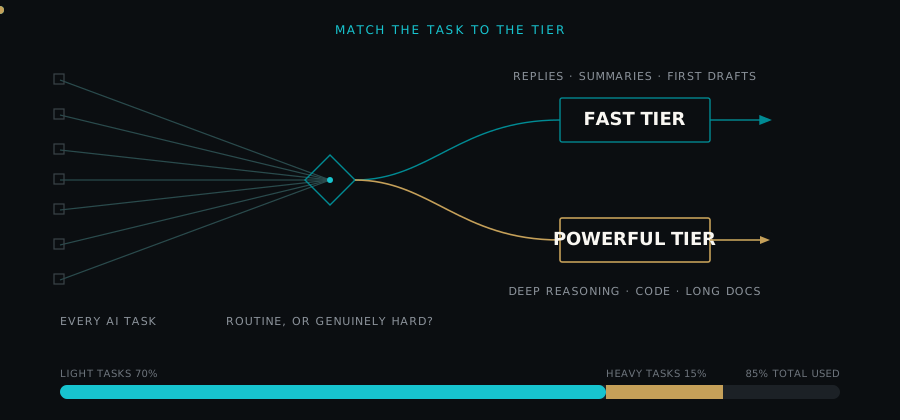
Strip away the branding and OpenAI, Anthropic, Google, and xAI all ship the same idea: a fast, lightweight model for high-volume routine work, and a slower, more expensive-to-run model reserved for problems that actually need it. The mistake that burns through a usage limit fastest isn't using AI too much. It's using the heavy model for light work.
OpenAI. OpenAI's own guidance splits ChatGPT's models by how consequential the output is, not just how hard the question sounds. [1] Its fast, "Instant"-class model is built for everyday work that needs speed, such as drafting customer replies, writing internal messages, and summarizing a policy. [1] A "Thinking"-class model is for work that's genuinely harder to do in a single pass: multi-step reasoning, long documents, and anything that chains several tool calls together. [1] The top-tier "Pro"-class model is reserved for the smallest slice of work, meaning output that has to be right the first time because it's expensive or awkward to redo. [1] OpenAI's newest flagship, GPT-6 Astra, launched September 3, 2026 and is rolling out inside ChatGPT chat to Plus, Pro, Business, and Enterprise plans. [2][3] It's the most capable model OpenAI has shipped, which is exactly why it isn't the right choice for a routine email. The guidance above still applies to when you reach for it.
Anthropic (Claude). Anthropic's current lineup runs, fastest to most capable, Haiku, Sonnet, Opus, and Fable. [4] Haiku is built for fast, cost-effective, high-volume work, such as bulk customer replies or quick summarization. [4] Sonnet is the general-purpose default, balancing speed and intelligence for most day-to-day tasks. [4] Opus is aimed at complex agentic and coding work and is Anthropic's recommended starting point for anything demanding. [4] Fable is reserved for the hardest reasoning and longest-running work, and Anthropic's own advice is to reach for it only when Opus falls short. [4] On usage specifically, Claude's official best-practice guidance is concrete: batch related questions into one message instead of sending them one at a time, use Projects so reference material is cached instead of reprocessed on every turn, and check the Settings usage dashboard to see where a five-hour session or weekly limit actually stands before it becomes a surprise. [5]
Google (Gemini). The Gemini app runs three tiers, Flash-Lite, Flash, and Pro, available on every plan, including free. [6] What changes with a paid plan isn't which models you can reach, it's how much you can use them: usage is compute-based rather than a simple message count, limits refresh on a five-hour cycle until a weekly cap is hit, and a paid subscriber who hits that cap can keep working on Flash-Lite instead of being cut off entirely. [6] Flash-Lite is the everyday-task tier, Flash balances speed and reasoning for most work, and Pro is for the complex math- and code-heavy jobs worth the wait. [6]
xAI (Grok). Since June 2026, Grok has run on one shared weekly usage pool across chat, image and video generation, and coding, replacing the separate daily limits it used to have per feature. [7] The pool resets weekly on a per-user schedule, and the practical upshot is that a plain text exchange costs very little of it while a high-quality generated video or a long coding session can consume a large share in one sitting. [7] The lesson for a subscriber who wants headroom left for the work that actually needs Grok's heavier features: don't spend the pool on text chat you could run through a lighter tool.
The takeaway isn't complicated
None of these systems are asking a small business owner to become an AI power user. They're asking for one habit: before typing, ask whether the task is routine or genuinely hard, and pick the model tier accordingly. Routine work, such as a reply, a summary, a first draft, or a quick answer, belongs on the fast, cheap tier every time. Save the top-tier model for the handful of tasks each week that are actually worth its cost: a document that has to be right the first time, a problem with real logical depth, or code that needs to hold up under scrutiny. That single habit is most of what separates someone who hits their usage limit by Wednesday from someone who never thinks about it.
The bottom line
Every AI vendor a small business is likely to pay for, including OpenAI, Anthropic, Google, and xAI, publishes the same underlying advice: match the model to the task, not the task to whichever model is already open. Follow that, and a subscription that felt tight starts to feel like more than enough.
References
- OpenAI Academy, model selection guidance for GPT-5.3 Instant, GPT-5.4 Thinking, and GPT-5.4 Pro. https://academy.openai.com/public/clubs/work-users-ynjqu/resources/latest-model
- Axios, "OpenAI releases new model GPT-6 Astra, says it may represent AGI," September 3, 2026. https://www.axios.com/2026/09/03/openai-astra-gpt-6-agi-brockman
- CNBC, "OpenAI announces rollout of GPT-6 Astra model," September 3, 2026. https://www.cnbc.com/2026/09/03/open-ai-astra-gpt-6-cyber.html
- Anthropic, "Models overview," Claude Platform Docs. https://platform.claude.com/docs/en/about-claude/models/overview
- Anthropic, "Usage limit best practices," Claude Help Center. https://support.claude.com/en/articles/9797557-usage-limit-best-practices
- Google, "Gemini Apps limits & upgrades for Google AI subscribers," Gemini Apps Help. https://support.google.com/gemini/answer/16275805?hl=en
- Grok (xAI), official statement on the shared weekly usage pool, June 2026. https://x.com/grok/status/2074743608389906873