
The Answered-Call Gap: What Missed Calls Actually Cost a Business
A number keeps circulating in the automated-answering industry: 62 percent of small-business calls go unanswered, at a cost of $126,000 a year. Both figures trace back further than they're usually credited, and one of them cannot be traced at all. Here is what the evidence actually supports, what it doesn't, and what a business should do about the calls it can't get to during the hours no one is at the desk.
A phone rings on a desk after the last person has gone home. Nobody picks up. Somewhere between one ring and the seventh, the caller either waits for voicemail, hangs up, or calls the next name on their list. Multiply that moment by every after-hours call a service business receives in a month, and you have the shape of a real problem. What you do not automatically have is a reliable dollar figure for it, no matter how many marketing pages insist otherwise.
The number everyone cites
Type "missed call statistics" into a search engine and the same claim appears on dozens of pages: 62 percent of business calls go unanswered. [1] The number is real, but it is not new, and it is not what most of the pages repeating it imply. It comes from a single self-published study by 411 Locals, a directory-listing company, which monitored the phone lines of 85 businesses across 58 industries for 30 days in 2016. [1] The company's own breakdown of that sample: 37.8 percent of calls were answered live, 37.8 percent reached voicemail, and 24.3 percent got no response of any kind. [1][2] Rounding the two unanswered categories together produces the 62 percent figure in circulation.
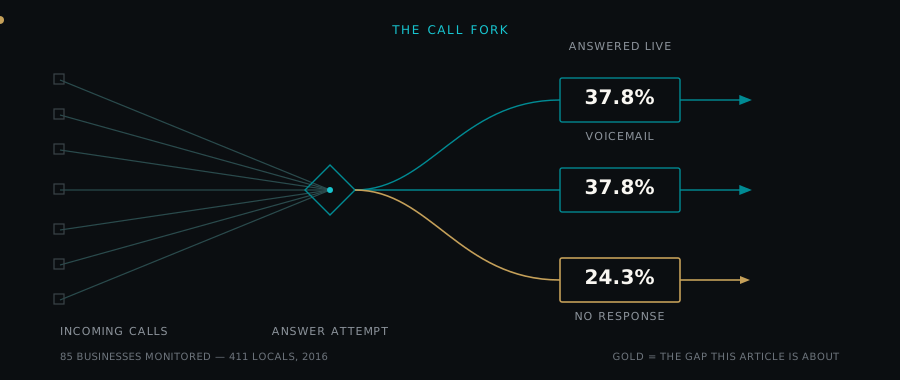
That is worth taking seriously and worth being precise about. It is one company's internal measurement of 85 businesses, a decade old, never independently replicated, with no published methodology beyond the topline numbers. It is the most concrete figure available on this question. It is not a current industry benchmark, and a business reading "62% of businesses lose almost two-thirds of their calls" in a 2026 article should know that the underlying data is from 2016 and from one source. [1][3]
The dollar figure that doesn't hold up
The second number is worse. Several current articles state that "the average small business loses $126,000 a year to missed calls," attributed to "research from Dialora," an AI phone-answering vendor. [2] None of the pages repeating it show the calculation: no average call value, no assumed close rate, no missed-calls-per-day estimate, no sample. [2] A separate cluster of the same articles cites a different vendor and arrives at "$26,000 a year" instead. [4] Two vendor-sourced numbers, off by a factor of five, both presented as settled fact, are a sign that neither should be treated as one. This is a market where the companies producing the statistic sell the product marketed as its solution, and readers should weigh the numbers accordingly. Sherwood has the same conflict of interest in writing about this topic, which is exactly why the honest way to handle these two figures is to name them as unverified rather than repeat them as fact.
A missed call is not free. Whether it is a $126,000 problem, a $26,000 problem, or something else entirely for a specific business depends on that business's own close rate and average job value, not on a number lifted from a vendor's landing page.
What the broader data actually shows
Pull back from the missed-call-specific claims and the picture gets more solid, if less dramatic. Hiya, a call-identification company, analyzed roughly 13 billion monthly mobile calls in the United States in 2019 and found that Americans answered less than half, about 48 percent, of the calls they received. [5][6] That study is six years old and measures personal mobile call answering broadly, not business landlines specifically, so it should not be read as a small-business statistic. It does establish, independently of the missed-call-marketing ecosystem, that a large share of calls going unanswered is a real and measured pattern in how people use phones, not an invention of companies selling the fix.
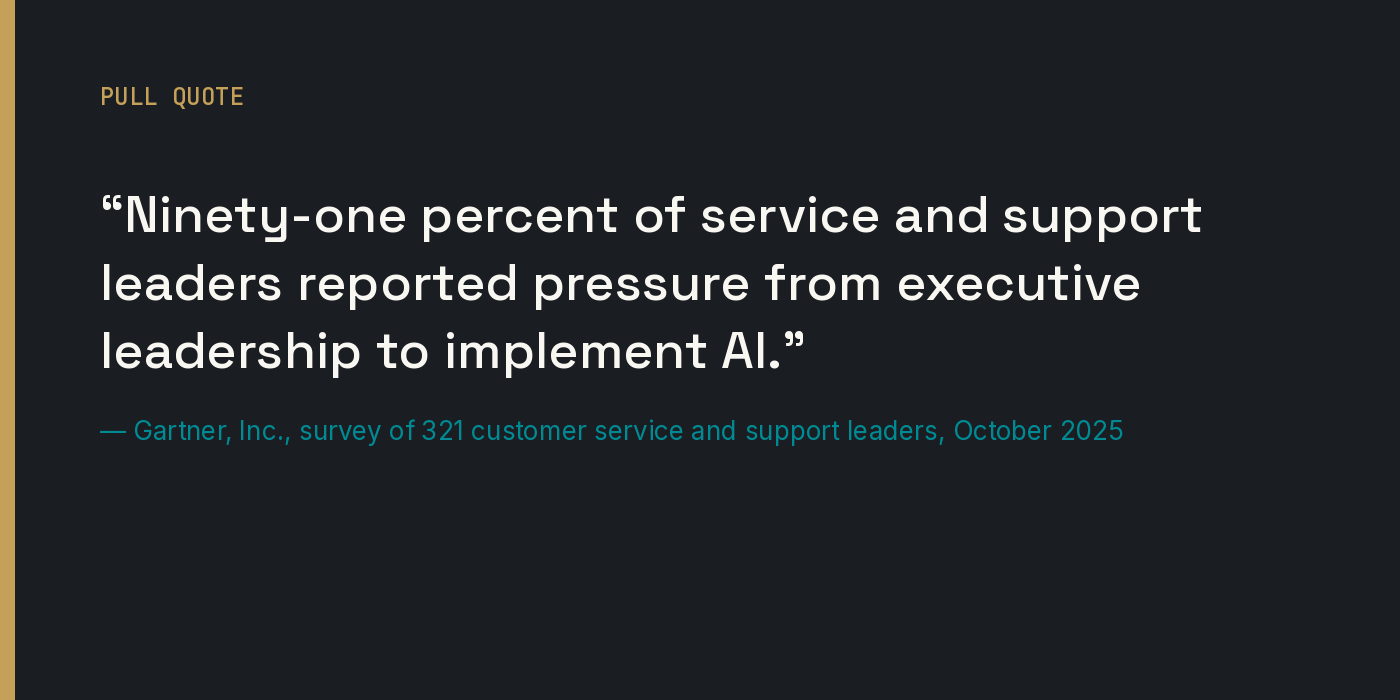
On the response side, Gartner surveyed 321 customer service and support leaders in October 2025 and found that 91 percent reported pressure from executive leadership to implement AI in their service operations, with roughly 80 percent of organizations planning to move at least some staff into new roles as a result. [7] That is not a statistic about missed calls. It is evidence of where the pressure in customer-facing operations is actually coming from right now: not primarily a hard dollar figure about lost calls, but a broader push to cover service gaps with automation faster than staffing models can otherwise close them.
Why after-hours is the sharper version of the problem
Set the shaky statistics aside and the operational logic still holds without them. A service business with fixed staffed hours has, by definition, hours when no one answers the phone at all, evenings, weekends, and whatever else falls outside the schedule. A call that arrives then does not reach voicemail because the line was busy or the staff was slow; it reaches voicemail because no one was ever going to pick it up. For a business where the caller has other options (another contractor, another dealership, another provider open right now), the after-hours gap is the moment where "unanswered" and "gone to a competitor" are closest together. That is a claim about incentive structure, not a claim requiring a specific loss figure, and it is defensible without the vendor statistics above.
What to actually do about it
A business deciding how to close this gap has real options, in rough order of how much they commit to:
Extend live coverage. Staggered shifts, a shared after-hours line across locations, or a part-time evening receptionist all keep a human answering, at the cost of payroll for hours that may see low call volume.
Use a human answering service. Third-party answering services have covered this gap for decades. They cost less than direct staffing and more than automation, and quality varies by vendor.
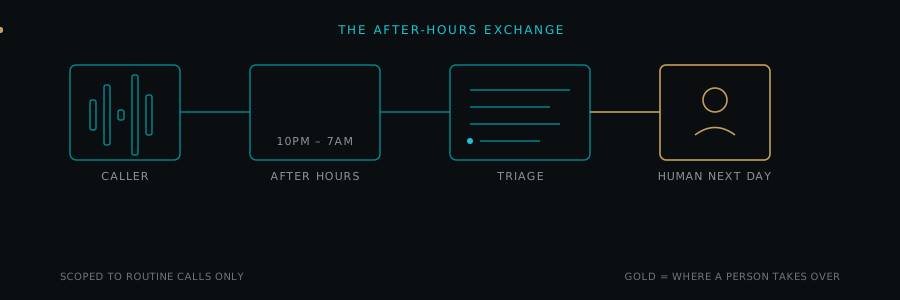
Use an AI voice agent for defined tasks. The realistic case for AI here is narrow and specific: answering, triaging, and scheduling routine after-hours calls (appointment booking, basic questions, message-taking) and handing off anything ambiguous or high-stakes to a human the next business day. That is a scoped tool for a scoped problem, not a full replacement for judgment calls a caller might need answered on the spot.
Whichever option a business picks, the same operational guardrails apply regardless of who or what is answering the phone: decide in advance which calls a person must handle personally and which can be triaged automatically; make sure whoever or whatever answers knows exactly where its authority ends and a human's begins; and require a human confirmation step before anything consequential happens as a result of that call (a booking that involves payment, a commitment on price, a cancellation). Those boundaries matter more than which vendor's number sounds most alarming.
The bottom line
The 62 percent figure is real but small, dated, and single-sourced. The $126,000 figure has no visible methodology and is contradicted by a competing vendor's own $26,000 claim. Neither survives being checked. What does survive: a meaningful share of calls to small businesses go unanswered, after-hours gaps are the cleanest version of that problem because no one was ever going to answer, and the response options range from more staffing to a narrowly scoped automated first line. A business doesn't need an inflated dollar figure to justify deciding it wants its evening and weekend calls handled by something other than a ringing, empty desk.